
Great article detailing the history of the paintings provided
I have been having dreams lately. Cold dreams. Large ones. Stuff I’ve drifted and grueled through. Sometimes it takes away my real rest and presents a strange kind of journey that I wait for as I pass into sleep.
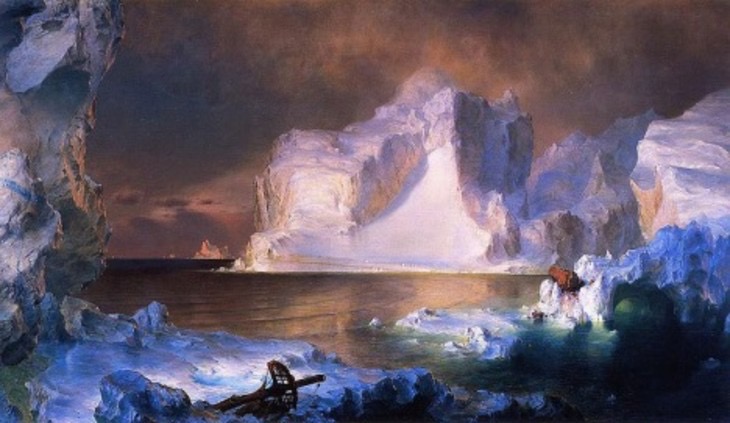
It started a few weeks ago when I accidentally turned the air down to 60 on the AC and shivered my way through a rainy April. That first night, I had a dream that I was on an almost infinite arctic plateau, near the edge, overlooking a massive ocean. Clouds billowed all around, and when I turned, there was a sublime wall of dark storm crowding the valley (Because the ice I stood on had on both sides mountain ranges stretching infinitely back with the glacier, like the Wall in Game of Thrones). My mother and I were in a small orange tent with a yellow snowmobile crashed into the ground and covered with snow beside. My mother was wrapped up in a sleeping bag, and her eyes looked catatonic. She didn’t shiver like I did. We could feel the storm coming from a black chill in the bone, the approach was slow and inevitable and beyond scale.
My sister had fallen off the jagged glacier edge. It was not a flat cliff but started descending towards the ocean with deep blues and greens, sinking into a monstrous black where light cannot find. She was in the water. I knew she was yelling, but I could not hear her. My stomach hurt. My mother begged me not to leave her in the storm. She could not bear to lose another child. My father was not in my thoughts once.
But outside the tent, I went to save my sister. Just in the middle and ahead of this great glacier pass in the water, just past the edge of the cliff face, was a mountain of ice 200 feet tall. It had a flat face halfway through the mountain, falling right into the abyss with a sharp, rigid back. The other side was covered in snow and deceived an untrained eye with its smooth shell-like curves. I peeked my head over the right side, and there was nothing very bothersome, just the cliff face, which stood about 20-40 feet above the ocean. The left, however, the side of the small mountain’s flat face, was cascading ice blocks leading down to my sister in full snow gear, thrashing about in the water. The dream ends with me struggling to grasp her. I ended up having one more dream where I was on an Arctic survey trip with college friends.
^Glacier Sounds: Ice falling into water.
So then I found this Coleridge poem! I found some analysis questions from a college worksheet I’ll use to guide myself through the poem.
Part I
Why does the Mariner stop “one of three”—in other words, that particular wedding guest? With no valid description of the man or his motivations, I can assume this is an overtly symbolic, and his sudden removal from a grouping of love represents man in his cold (Natural theme of the poem) isolative state. It is not clear how far this reflects the contemporary society, but is always a mjor theme of Romantic poetry. Literally, he is caught within the Mariner’s grasp, he just cannot help get away.
Why does the Mariner prevent a man from attending a wedding? Is a comment being made on a wedding celebration in comparison with other experiences? Maybe the wedding is being downplayed as an essential element of life’s experience, contrasted with that of the great journey of life (AS found in the Arctic expedition), and again, the isolated nature of an Arctic expedition reinforces a feeling of an alienated individual. But without a prompt, I would not have found any textual details supporting this so far in part 1. I would have gotten that idea if he were the bridegroom.
How does the Mariner stop “one of three”?
“He holds him with his glittering eye” after first grabbing him by the wrist. Deleue makes a deal of the eye when he looks at Melville and Claggart, particularly. The eye is the instrument of recognition. Deleuze talks about a monomania in the 19th century, and a kind of depraved perspective. Expressive eyes that tell only of appearances, which only deceive. A man of hate a resentment, let’s see if it’s the same here.
What does moon-sun/night day have to do with the story? What kind of things happen under those planets or at those times of day?
The rise of the sun marks the beginning of the journey, and its setting marks the departure movement into “The Heart of Darkness”. He also kills the Albatross during the night, under the light of the moon.
In what terms is the setting out of the ship described?
In merry terms, as the sun rises.
Why do the mariners hail the bird as a Christian soul?
it is familiar! It stays around! No other life is mentioned, though when it ends up being “unjustly” killed, it may be beacuse it is a Christ figure.
How does the bird relate to the mariners?
Is it adrift? I don’t know. It simply eats and moves forward.
Why does the Mariner shoot the albatross?
Cause he can. because that’s what things do to eachother.
Is his act premeditated? If it’s Christ, then yes, by an Evil god haha this dude can’t stop killing sons. But no, I think this is a death of God which is unconscious and not planned, which is opposed to a thorough Christian reading; eschatology is the most important part of the early church and what makes Christian hermeneutics so important. Though it is pretty Christian that the bird will come whenever you call for it.
Part II
The beginning of this part starts with the Sun now rising on the opposite side, as they have crossed the Southern pole. It is silent. They are in the heart of the storm. Some are haunted by the death of the Albatross,
“And some in dreams assurèd were
Of the Spirit that plagued us so;
Nine fathom deep he had followed us
From the land of mist and snow.” An allusion to Dante, in the # of levels of hell. They are no longer followed in a forward reality, but shrouded in dreams. Covered unconsciously.
Why do the mariners change their minds about the value of the bird?
Jamie is right! (My girlfriend). It is because the bird removes the wind and fog. Is this animism? Is this the shedding of the last remaining strand of Paganism in the heart of Christianity? The poem speaks to me more here about a pragmatic sensibility, one that develops in the wake of the Death of God a la Nietzsche, and through the Enlightenment. Through reason, we have abandoned a cruel and unceasingly mystifying Nature(Trying to draw allusion to the mystical here). However, as Deleuze notes, reason was a major aspect of the megalomaniac; it was only his actions that were insane, not his logic.
What does the Mariner’s not being able to speak signify?
Well, one, they have no water. But it may signify an incommensurable gulf in communication between men beyond the Death of God and purity. The Albatross is white after all.
What’s the significance of drought and idleness?
The state of Modern society. Jamie says “drought”. Precisely. Dried up. Withering. Decadent. The faith in life is extinguished.
Why does the crew hang the albatross around the Mariner’s neck?
Because it’s unavoidable! The mark of Christ has stained the legacy of the West. Jamie also nots an Albatross looks like a cross when flying.
What does the bird have to do with the cross? Why should it be related to the cross?
See above! Also again, it’s white!
Part III
What is the “spectre-bark”? Who is on it? Is it really there? How do you know? Who else sees it? How do you know? The specter-bark seems like a ghost ship filled with “Four times fifty living men,
(And I heard nor sigh nor groan)
With heavy thump, a lifeless lump,
They dropped down one by one.
The souls did from their bodies fly,—
They fled to bliss or woe!” Perhaps Coleridge is complaining bout the history of man replacing Christ and sees death in historicism. There are two people, Lady Death and LIFE-IN-DEATH. I would think that because he saw the ship as the sun set and raised the happiness of the crew, he was then telling the truth, but then the auspicious return of the Moon (A figure of deception for a long time) has the crew disavow him. “One after one, by the star-dogged Moon,
Too quick for groan or sigh,
Each turned his face with a ghastly pang,
And cursed me with his eye.”
What does the act of rolling dice to determine fate mean about the nature of justice in the Mariner’s universe? Or, if you believe the scene is a hallucination, what does rolling dice mean about the nature of justice in the mariner’s mind?
It is about the nature of justice not being accessible to the human eye. Or more precisely, the justice of death. The idea of suffering. It is one ruled by chance. Life is also in death, for the Mariner. For the man of hatred and resentment, the one with eyes that harken to eat the dreams of others.
Why is justice an issue? What have the mariners done to deserve their fate?
They have killed the Albatross! They have transgressed!
Why does the Mariner get the punishment he does?
Because in killing Christ/Albatross, he has abandoned mankind alike.
Why does everyone die but the mariner? Why are their deaths compared to “the whiz of my crossbow”?
See above! They are essentially the same.
I’ll provide a comprehensive view when I finish the poem tonight or tomorrow. A lot could be unpacked from the description of death and the boat.
 Rustle in the Bush
Leave a comment