
The Necessary Revision of Metaphysical Concepts
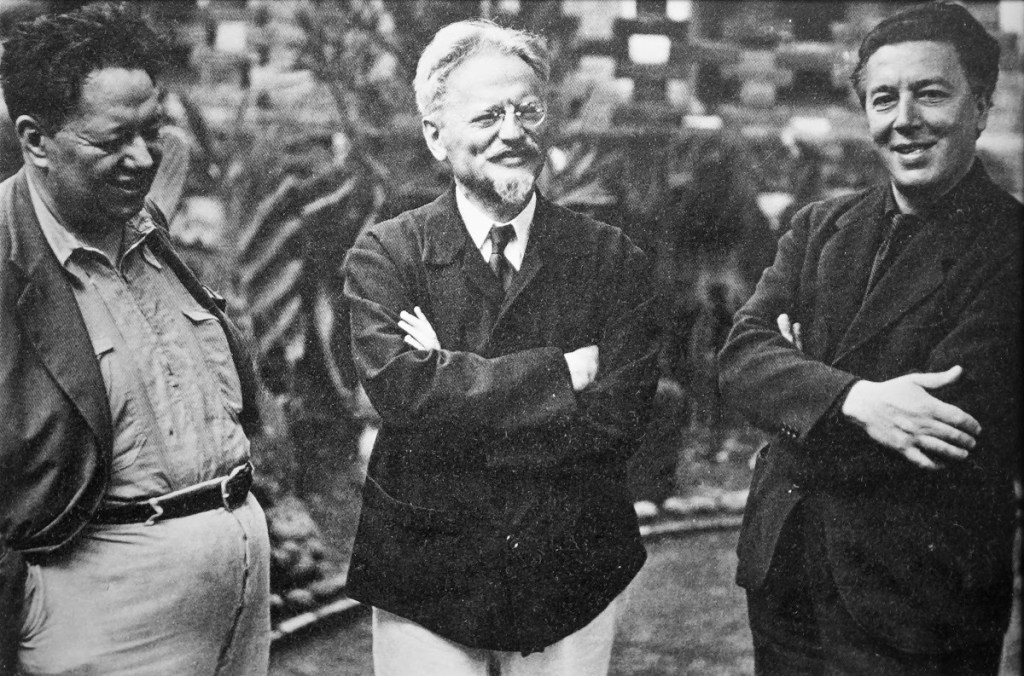
Unrelated, but this was the sort of era that Wahl is coming out of. Riviera, Trotsky, and Breton. What a meeting! The era consumed by empty revolution.
So! Looks like this book, insofar as a textbook, can be classified as one on the history of metaphysics in two ways
- How some ideas have been modified in different ways in different times
- How some of these ideas have remained realtively unchanged
As far as the Pre-Socratics go they all had a fundamental metaphysic. With fire, water, or air, or a number with the Pythagoreans. (Obviously, Parmenides believed in the ‘One’ and Empedocles saw a metaphysical dualism between love and strife).
Wahl says that what was unique was the lack of difference between the spiritual and the material (I guess you could see this in the soul as being a kind of breath, pneuma). The Pythagoreans thought that what was important was that things in the world as we perceive them participate in the numbers, which are the real, substantial things. Wahl sees a similiar progession into Socrates and Plato. Pre-Socratics and Plato/Socrates
| Philosophers | Metaphysic/Starting Point | Central Concept |
| Milesian School (Pre-Soc) | Substances | Fundamental Being |
| Pythagoras | Numbers | Participation in # |
| Plato/Socrates | Ethics | Imitation of Form/Idea |
* Wahl notes that substance is the main concept for Aristotle and Leibniz, and they both connect it heavily to their logic
“So far we have considered certain features of philosophical speculation that have remained unchanged up to the present: the importance of mathematics, ethics, and art, the predominance of the sense of sight; and the influence of grammar and a certain conception of biological inheritance.” So we have handled this first part. The problem of forms and the form of forms, which plagued Aristotle and Plato. So we see how they have stayed the same, what aspects have radically changed? Wahl says this is the introduction of Modern philosophy (For the remainder, Modern/Early Modern starting with Descartes).
Plato and Aristotle’s concepts which have stuck
| Philosopher | Substance | Attributes |
| Plato | Participation in Ideas Dualism in substance | Substance is attribute of realm of ideas |
| Aristotle | Plurality of substances | The subject has attributes Subject as a substance |
The theory of ideas of forms then has a few potential bases from which to start. Ethical, mathematical, and for Plato, the artisan as well. Wahl finds this based from the fact that the Greek city-state was one of artisans. What happens when a person wants to make a thing? Are they the same kind of things as ‘natural objects’, i.e., the world? Or do we add something to the world? It opens up real philosophical questions like this. For Plato, in Part Wahl sees this in the Demiurge, who chooses ideas to craft into the world, and then a later bent of Plato towards mathematics where artisanal inventions don’t hold the same degree of reality.
But as he notes, at least for us looking back today, we are still discovering numbers, making art, and deliberating Ethics. For Plato and Aristotle, there is always the Maker of the ideas and the matter through which he makes them.
The word that denotes this is Eidos, which is Idea in Plato, and Form in Aristotle. I did not know this. Idea is also the Platonic word and the meaning is ‘thing seen’, where Wahl shows how visual metaphors have dominated philosophy.
Here he goes over Plato vs Aristotle to show their ‘revision of metaphysical concepts’. Plato and Aristotle, however, both start with art over Ethics and Math.
Transition from Ancient to Modern
There’s a lot of conceptual work here. It’s fun, but being familiar with the arguments is the key part of philosophy. I should return to some of these Platonic texts he mentions.
Wahl sees a big concept missing is that of time. The ethical, mathematical, and artistic are relatively untouched by he concept of time in the Ancients, and even by Descartes. For the ancients, time was something received; it was eternal and unchanging. We look for truth in what is atemporal. We see in this that there really isn’t an emphasis on progress, which is a central idea in the Enlightenment. The result of this is that the Greeks generally prefer the finite over the infinite.
In parallel, for Plato, the soul participates in ideas, and the ideas are, in a way, prior. For the start of modern subjectivity (Wahl attributes this interpretation to Bergson), with the cogito in Descartes, the soul is placed above ideas.
“In ancient philosophy, the soul contemplates the Ideas; modern philosophy tends to conceive the soul as, in a sense, the source of the Ideas.” (Pg.6)
According to Wahl (And history), this has to do with the Rise of Christianity. Christianity is eschatological first of all, so all history progresses towards judgment day. But more importantly for Wahl, Christ represents a middle point where the infinite reaches the finite; God incarnating himself among men. Things only have meaning in relation to this event. Augustine is identified as the first to introduce time as a major concept.
“Thus the idea of progress and the Christian conception of the self-transcendmg moment of incarnation tended to replace the ancient conception of timelessness.” (Pg.7)
The second major advance was that of science. In this, it switched the place of quantity and quality in definiteness. Quantity was indefinite in Plato, going always towards more or less. Quality was more definite. For scientists, quantity is highly measurable and more definite, whereas quality is something we seem to view on a spectrum.
There is a great parapgraph here: “If we wish to view in its totality the world as it is conceived by most of the thinkers of the modem period, we shall first see God— who is called by them the infinite— at the summit, then the finitude of quantity and of the clear and distinct ideas, and then at the bottom the indefiniteness of qualities. The qualities of matter, at least the secondary ones, have become indefinite; quantity is now considered as coinciding with the finite; and as for the idea of the infinite, it has become separated into God, on the one hand, who may be called the good infinite, and, on the other hand, the bad infinite, or rather the indefiniteness of qualities.” This summarizes these changes and how they relate to fundamental movements in religion, as I noted Wahl’s emphasis in the first post.
Starting Modernity Rationalism
As I noted above, when saying the moderns put the soul as the source of ideas, we see Wahl reiterating this. There is a new birth of subjectivity not tied to Aristotle’s subject/predicate form strictly. The only valid substances which fit this form are extensions and thought (Res extension; res cogitans), and thus the new science was founded solely on space and motion.
What Descartes kept was the theory of Ideas and simple natures. The rationalist idea taken from them is found in Descartes’ ontological argument, whereby from the idea of existence, we have a clear (Thus real) conception of God. We also have him reintroducing the Great Chain of Being, in which there are grades of this perfection (Being God as a strange kind of third substance, thought, and then extension; let alone the Christian grades of creation).
Wahl shows these Cartesian presuppositions:
Space – Made up of separate points (I believe this is in aprt due to his geometirc coordiante plane; which revolutionzied science and math)
Time – Time is made of separate instances. I remember in my other reading group that Descartes believed creation needs to be an active process. So that God is creating the world at any given instant for it to have any kind of continuity.
The ‘rationalistic’ theories end up finding their way into Kant. the idea that appearances (phenomena) presuppose things-in-themselves (noumena). Kant holds that for something to appear, there must be something that appears, even if we never have direct access to it.Wahl says what Kant keeps is a form of matter dualism. Matter (The thing in itself) is never known, but the structure of the activity of the mind (For Kant, the table of the categories) can be known by the mind.
Starting Modernity Empiricism
Wahl accuses James of saying earlier empiricists such as Locke and Hume only paid attention to ‘disparate terms’ and that the rationalists focused on the relations between them, and that is their strength.
Wahl seems to think that the advent of all these new fields (And in particular, he mentions psychoanalysis and overdetermination, whose strengths lie in showing multiple causal chains are effective) has left what I call high modernity at a point which is at its most intellectually self-critical. As someone had put it in a reading group, regarding the origins of fascism- ‘We’ve failed the symbols’. Wahl puts the crisis as such:
“The classical principles have vanished; the frames have been shattered. In fact, there are no longer any frames, and the very things that were in these frames have themselves disappeared. Thus, we are confronted by an intricacy of phenomena of which the classical philosophies give us no idea. We are in the presence of a no-man’s land, even a no-word’s land.”
I’m not sure what Wahl means by poets saving the face of revulsion of philosophy following this trend, other than some emotional consolation. I am also not strong on Existentialist philosophy, and he locates what is unique in Husserl and Heidegger in the nature of thought. The principle of intentionality states that thought is always directed to something other than itself, and for H+H, something other than ideas.
According to Wahl, James rejects Descartes’ representationalist theory of ideas by saying that representations hold reality in their own ‘new context,’ i.e., experience for James. Why? Descartes says metaphysically that spatial extension is prior to the reality of individual objects, which is how they are represented in the context of experience for James. This leads to a philosophy where individuals, especially men (And their bodies), stand in a natural relation to what transcends it in a way (Not eliminating the reality of these in favor of extension): For Kierkegaard, it is man to god. For the secularists and upright scientists, it is man to the world in Whitehead.
So relations that man has to the world are nexessary aspects of knowledge. he provdes some examples.
| Movement | Thinker | Action/Knowledge Relation |
| Pragmatism | James/Dewey | Knowledge as value Ignoring trad. fact/value distinctions’* |
| Phenomenology | Heidegger | Technology |
| Intuition | Bergson | General ideas have origins in preperation for action |
| Naturalism/Process Naturalism | Whitehead | Indiviudal objects in thought are tools for action |
* Fact/Value distinction being what Wahl says here”
“Our world ceases to be a world of pure space, even a world of pure phenomena; it is no longer the world of Descartes or Hume or Kant, but a world in which things present themselves in their partial wholeness, in their opacity.” (Pg.11)
Wahl glosses the end of the chapter, reiterating that philosophical life is founded on a dialectical movement between ideas and that we both see a massive gaining towards the past and the advance of thought being genuine (As seen in science). So we see Wahl as a dialectician, but in some ways, I’m weary of creating a transcendent gulf between man and existence. Deleuze will pick up the mantle against these dialectical ways of thinking.
Planning on writing a 300-word summary of what I thought I learned in this chapter to be posted to the forum.
 Rustle in the Bush
Leave a comment