
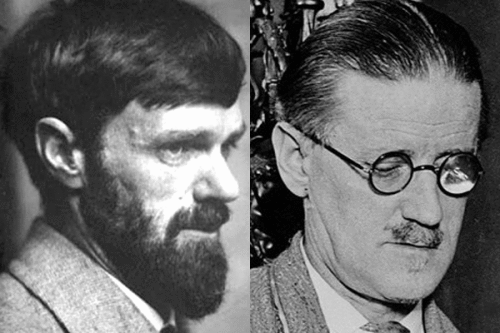
I finally got a collection of DH Lawrence essays called ‘The Bad Side of Books’ and it contains one of my favorite things rotten by Lawrence, an essay called The Future of the Novel written in 1923 at a time when Joyce was rolling.ne of my favorite things about this essay is him talking about Joyce.

Lawrence and Frieda 1923
Lawrence brings life into his thought immediately. I wonder how much of a conscious decision that this is. Birth. Death. Their meaning only taking place in time, in thinking of the future. All in this little metaphor. And of course, he asks about the life (So, really the future) of the novel in his 1923. Ulysses had just been released. I know from a foot note that he actually thought it was more like, “okay” at first, but the polemicists job needed done.
The original title gives this feeling away, and changes the feeling of the article. Rather than just its future, we have our means of securing something about it; exploratory surgery. Lawrence will probe the popular novels of his time and discover two sorts.
His modern novel is a “Monster with many faces” with a “Siamese Face”. And here we see the textual overdetermination of the novel, our what Bakhtin calls the Carnival, or what my social justice classes call intertextuality, or what Foucault calls discursivity. Since Don Quixote, the novel has been the form of art which examines itself the best (Or maybe the most often; Dorian Grey showing the salutary effects of the man(Life)/art synthesis later; and encapsulated by the novel represented through Dorian’s aging artwork reproduction).
And this is even in the first novelistic trend the ones which are “the pale-faced, high-browed, earnest novel, which you have to take seriously” as opposed to the “smirking, rather plausible hussy, the popular novel”.
The first has its representatives. Joyce, Richardson, and Proust. What a wordy bunch! I think Rusell said of Hegel somewhere that his books were like trying to swallow a whale. That’s why I put down Proust. Richardson looks interesting as well. Apparently she was the first major modernist author to pioneer the stream of consciousness technique. Stream of consciousness actually got its name from William James who was trying to describe her style.
On Joyce “Is Ulysses in his cradle? Oh dear! What a gray face.” Haha Lawrence is doing what any good Olympics does. He is calling the baby ugly. What he is going to be calling into question is the extent of their self reflection. A childish interest in the phenomena he calls it. 14 volume agony. Death rattles. It is nice to hear from someone that books really matter and the brief guilt I had for a second at not having read Miss Richardson’s 14-volume series dissipates quickly. Listen to this lovely perfectly descriptive grudge:
“Did I feel a twinge in my little toe, or didn’t I?” asks every character of Mr. Joyce or of Miss Richardson or M. Proust. Is my aura a blend of frankincense and orange pekoe and boot-blacking, or is it myrrh and bacon-fat and Shetland tweed? The audience round the death-bed gapes for the answer. And when, in a sepulchral tone, the answer comes at length, after hundreds of pages: “It is none of these, it is abysmal chloro-cor>’ambasis,“ the audience quivers all over, and murmurs: “That’s just how I feel myself.”
How goddam funny is this. Paraphrase: A self consciousness pulled apart bit by bit, and you have to go by smell. Brilliant, haha. I think the heart of his issue is not just the exorbitant length, but also the concerns he shares about Whitman. You’re breaking yourself up really to be swallowed by something. They have trouble letting things stand as they are, without moralizing. As he says about Whitman “No, no Dear Walt! I do NOT want all that in me thank you”.
There’s a strange cult of feeling that’s never went away in art because of works like this. Just get a few beers in me and I’ll start my diatribe against spoken word poetry… Buy its true these people are imminently concerned with the way they are feeling, and how they are feeling. How am I? What am I? Again hilarious, ““That’s me! That’s exactly it! I’m just finding myself in this book!” Why, this is more than death-bed, it is almost post-mortem behaviour.”
I’ve noticed this problem a lot when reading people’s reviews of literature. So concerned with how they feel about the book, or what they don’t like it in the content. Well, dummy. The book doesn’t want YOU or YOUR silly stupid little feelings. Nobody cares about those!! Let alone this book. Shit, the authors feelings kind of don’t matter either so why should yours? Because as Lawrence diagnoses… “My reactions arc such, and such, and such. And, oh. Lord, if I liked to watch myself closely enough, if I liked to analyze my feelings minutely, as I unbutton my gloves, instead of saying crudely I unbuttoned them, then I could go on to a million pages instead of a thousand.”
There’s something interesting about this idea of immaturity and childishness. A certain care about words that only exists for young girl now dominates our political sphere.
Maybe that’s the case with intellectuals. The political sphere as it belongs to the people are found in the popular novels. Only this time it’s a sickening moralizing, which again, is only a kind of attitude that can be maintained by children. DO this, don’t do that. Like Marvel movies I guess. Thinly veiled prescriptions you realize that you already discovered in the 3rd grade.
“The purely emotional and self-analytical stunts arc played out in me. I’m finished. Tm deaf to the whole band. But I’m neither blasi nor cynical, for all that. Tm just interested in something else.” We all feel this way often. But to feel this way about life is a blasphemy. And a novel with no life, or no life boosting properties is just a corpse of someone’s emotions. Stinks.
So he says! We must break through the wall of life for the novel. Or imagine a bomb underneath it until the, “democratic-industrial-lovey-dovey-darling-takc-me-to-mamma state of things is bust.” (I wonder what kind of mixed reactions he would’ve had to Pynchon, Roth, and DeLillo. They don’t seem awfully abstract, but what else can all those words amount to. We’ll see…
So! Lawrence calls for the merge of philosophy and fiction again in the novel. A way o make myths. To organize men. This seems something like what Bataille wanted as well. They would’ve hated each other probably, but they realized we needed things to point to the sky, and I could use that for sure (At least in a book). There’s nothing but brick vistas for men in Newark. Here’s Lawrences passing remarks in the case that these books get made,
“And the public will scream and say it is sacrilege: because, of course, when you’ve been jammed for a long time in a tight corner, and you get really used to its stuffiness and its tightness, till you find it suffocatingly cosy; then, of course, you’re horrified when you see a new glaring hole in what was your cosy wall. You’re horrified. You back away from the cold stream of fresh air as if it were killing you. But gradually, first one and then another of the sheep filters through the gap and finds a new world outside.”
 Rustle in the Bush
Leave a comment