
The texts I’m using are to be found in ‘Karl Marx: A Reader’ published by Cambridge University Press, 1986, edited by Jon Elster. Fuck MLA citations, simply. The first section is a quasi introduction to ‘Marxist methodology’. These pieces are the Introduction to the Grundrisse, selections from Theses on Feurbach, and selections from The German Ideology. The thing I enjoyed about these selections is that they present nothing but a relationship to methodology, and don’t attempt to provide a reading of Marx that is systematic.
To preface any writing on Marx, it is absolutely necessary to address (And I hate the term) the ‘layperson’s’ conceptions of free will and determinism. Both are language traps. A form of compatibilism is necessary to be an active individual. We have facticity as individuals and this Heidegarrian concept of ‘throwness’ (Not to misappropriate words I haven’t really read in context) is undeniable. The idea that Marx forthright rejects the agency of human beings, only goes to show you didn’t read enough. Anything else (I’m looking at you CosmicSkeptic and other fans of Hitchens style ‘public’ debates. Pinning limp dick pastors against big headed Dawkins style science fellas; boring as all get out. ) is Egyptianism roaring its bird head back towards Scholasticism.
The most difficult thing so far is readjusting to the language. It’s inherently political and economic, and I have to read much more carefully. However, the intro to the Grundrisse served really well to introduce the ‘process’ aspect of Marx, unless this is just my reading. The thinking is not representational. Marx is not looking for the grounding principals of the concept Capital, but attempts to analyze the historical conditions that brought them to fruition. And the constituent relations of Capital’s flow in and out of social productions. I fall back to Indra’s Net. ” ‘Production in general’ is an abstraction, but it is a rational abstraction, in so far as it singles out and fixes the common features, thereby saving us representation. Yet these general or common features discovered by comparison constitute something very complex, whose constituent elements have different destinations (Page 5)”. Deleuze says in the first line of Nietzsche and Philosophy that N’s most general project is introducing sense and value into philosophy. (A step away from representation). Marx does here too. From Theses:”The chief defect of all hitherto existing materialism (That of Feurbach included) is that the thing thing, reality, sensuousness (my italics), is conceived only in the form of the object or of contemplation, but not as sensuous human activity, practice, not subjectively…. Hence he does not grasp the significance of ‘revolutionary’, of ‘practical-critical’, activity.” For Marx, as for Deleuze thinking is a penetrating act spurred by it’s CC (Constituent conditions, new symbol). It is forceful and composed of forces. I now understand why revolution is necessary. A grand change in consciousness must necessarily bet met with violence to adapt with.
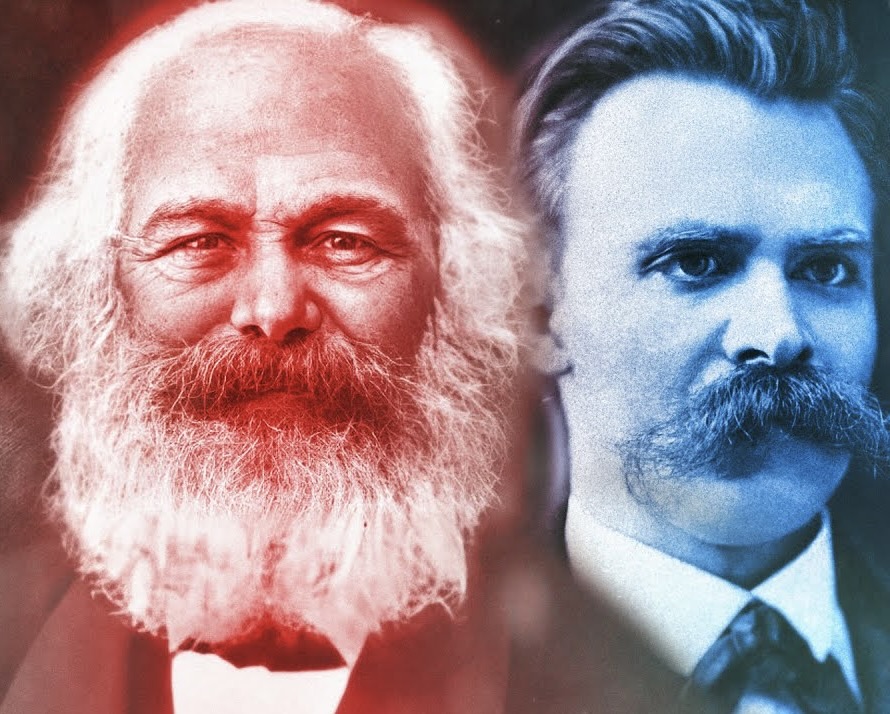
Marx, to his credit also spurns the empiricists/materialists who belong to a general collection of thinkers. (I know I know, generalities, bismillah! Sic temper tyrannous!) From German Ideology” The production of ideas, of conceptions, of consciousness, is at first directly interwoven with the material activity and the material intercourse of men (Page 27).” In the 10th aphorism in Feurbach, Marx calls out the old materialism for leading to “Civil-Society”, which is a cry for moralization and the problem Deleuze identifies in Hume. In the presence of a pure materialist empiricism, the positing of subjective principals falls into a “human nature”, be that what it may. (D’s Kant’s Critical Philosophy page 12). How else can this be said? Leave it to Nietzsche in Twilight of the Idols in the first passage from ‘Reason in Philosophy‘. It’s followed by a musing on Heraclitus, a nice connection. And to what else could Marx refer in that infamous aphorism,“The philosophers have hitherto only interpreted the world in various ways.The point, however, is to change it.” These are hammer blows of destruction. A firm “yea”. “To pose questions here with a hammer for once, and maybe to hear in reply that well-known hollow tone which tells of bloated innards.” (ToI preface).
Finally, Marx referred to the values of production (Which he claims political economy misappropriates through a post hoc rationalization, hmmm who does that sound like?) as being empty and antediluvian. This is the attitude which Nietzsche attacks as an antiquarian view of history in On the use and Abuse of History for Life. Thus, exchange value as a category (Not to mention positive) being unchanging, is a sick decadent value. It cannot be divorced from the conditions in which people experience and live through it. Knowledge of this concept does indeed change, and in this paragraph M’s remarks are similar to N’s ideas on over coming. It’s the result of the Will to Power. More points like these are to be found in Beyond Good and Evil, in ‘We Scholars‘. It is the problem both recognize in Spinoza which the positivists pick back up in an armful of dusty tomes, Sub specie aeternitatis.
 Rustle in the Bush
Leave a comment